A Nigerian broiler farm that smells of fresh maize and soybean dust is almost always a farm that is winning the cost battle. Feed, by every operator's ledger, eats the largest single share of the budget in any poultry business. For years the standard model in much of the country was simple: buy ready-bagged feed from a commercial miller, pay the price on the bag, and hope the exchange rate and the ingredient market stay kind. As flocks climb from a few hundred birds toward tens of thousands, that model stops scaling — and the farmers who grow instead are the ones who bring feed milling in-house with their own feed machines.
This case follows the arithmetic FOYA's export team sees repeated across Nigeria's poultry belt — around Ogun and Oyo in the southwest and into Kaduna in the north — as farms move from bought feed to an on-farm line built around a feed hammer mill and a feed pellet machine.
1. Where Poultry Money Goes in Nigeria
Roughly 60–75% of a broiler farm's operating cost sits in feed, and much of that feed is imported at the farm gate as a finished product. Between maize, soybean meal and the imported premix and concentrates used for a balanced ration, a Nigerian farmer buying ready feed is paying for the miller's procurement, drying, freight and margin on every single bag. When naira weakness pushes imported concentrates up, the miller's bag price moves with it — and the farmer has almost no lever to pull.
The lever begins with owning the conversion. Maize and soybean are grown in-country. Buy grain in bulk at harvest, grind it, blend the concentrate precisely, and press a uniform pellet — and the cost of a kilogram of on-farm feed lands visibly below the bagged alternative. That gap is the entire business case, and it widens the bigger the flock gets.
2. A Farm Crossing the 5,000-Bird Threshold
Take a representative grower outside Abeokuta running a broiler programme of roughly 5,000 birds per batch, four batches a year. Up to a few thousand birds the operator bought finished feed because hand-mixing grain and concentrate for a small flock was laborious and inconsistent. Once throughput passed a few tonnes of grain a month, the sums changed.
Each finished bird needed a certain weight of feed across its grow-out. Multiply that by 5,000 birds and several cycles, and the year's bought-feed bill ran into many millions of naira. Against that stood the cost of buying maize and soybean by the tonne, the running of a small diesel hammer mill to grind mash, and a pellet machine to finish it.
3. Bought Feed vs an On-Farm Feed Line
Representative figures for a 5,000-bird broiler programme; actual values track local grain, concentrate and diesel prices.
| Metric (per grow-out cycle) | Buying bagged feed | FOYA in-house line |
|---|---|---|
| Feed source control | Miller's price list | On-farm formula |
| Feed cost per finished bird | Baseline (100%) | ≈ 15–25% lower |
| Output per hour | — | Hammer mill + pellet line, ~150–300 kg/h |
| Batch-finish time for the flock | Order & delivery lag | Feed produced on demand |
| Grain purchasing | Not applicable | Bulk at harvest price |
| Feed wastage | Birds pick out fines | Uniform pellets reduce waste |
Reading the table, the saving is not one dramatic jump but a compounding stack: a lower cost per kilogram of feed, less wastage from sorted pellets, no margin and freight baked into every bag, and the freedom to re-formulate the ration as premix, maize or soybean prices move. Together those reduce feed cost per finished bird by a meaningful margin on the representative programme.
4. Scaling the Flock, Scaling the Line
| Flock scale | Feed need | Recommended FOYA equipment |
|---|---|---|
| ≤ 1,000 birds | Light daily batches | Small hammer mill only |
| 1,000–5,000 birds | Several hundred kg/day | Hammer mill + small pellet machine |
| 5,000–20,000 birds | Tonnes per day | Hammer mill + pellet line + feed mixer |
| 20,000+ (growing output for sale) | Multiple tonnes/day | Larger line, own grain intake |
The equipment is deliberately modular. A farm does not buy a full commercial mill at the start. It begins with a hammer mill on the mash that replaces hand-crushing, then adds a pellet machine, and later a mixer — each step chasing a lower per-bird feed cost as throughput grows. That stepwise path is exactly what FOYA sees fit the cash-flow of a Nigerian grower better than a single huge mill investment.
5. What Nigerian Farms Report After the Switch
- Feed cost per bird drops at scale. The bought-feed margin and freight fall out of the budget once grain is ground on-farm.
- The ration is always fresh. Feed is mixed the day it is needed instead of sitting weeks in a bag, so birds eat a fresher, more consistent diet.
- Pellets stop the pick-outs. Birds can no longer select maize and leave the protein, which quietly recovers lost performance.
- Scaling is cash-friendly. Add a mixer or a second hammer mill as the flock grows, rather than financing a mill at day one.
- Diesel keeps the line alive. Generator-fed machines ride out grid load-shedding during the critical brooding weeks.
- The flock drives the timetable. No waiting on a miller's delivery when birds are at peak appetite.
6. Sizing the Right Machines
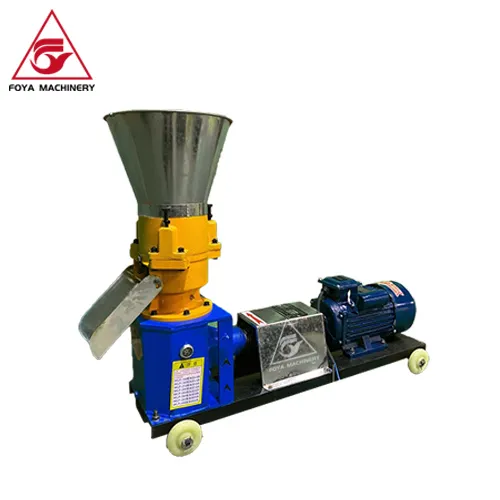
Matching the line to the flock matters more than horsepower. A FOYA hammer mill grinds dry maize, soybean and other grains to a consistent mash with interchangeable screens, while the feed pellet machine compresses the mash into dense 3–6 mm pellets birds eat cleanly. Farms that blend several ingredients — maize, soy, premix, molasses trays — add a feed mixer so every kernel carries the same ration. Choose electric where supply is reliable, or diesel-matched units for off-grid and generator operation.
7. The Bottom Line for Nigerian Poultry
Feed is the battle every poultry farm fights, and the farms that scale past a few thousand birds are the ones that stop taking the miller's price as given. Grinding and pelleting on the farm converts the biggest fixed cost into a controllable one — grain bought at harvest, ground fresh, and fed as a uniform pellet that birds convert well. In the numbers FOYA collects across Ogun, Oyo and Kaduna, that is precisely where the feed machines earn their keep: the feed bill per bird falls as the flock grows, which is the whole definition of scalability.
Frequently Asked Questions
Why do Nigerian poultry farms switch to their own feed machines?
Feed is the largest running cost in any broiler or layer business, and the price of ready bagged feed tracks miller margins and freight on top of grain and concentrate. Once a flock passes a few thousand birds, hammer-milling and pelleting on the farm cuts the per-kilogram feed cost and removes dependence on a miller's price list.
What does a small Nigerian feed line actually produce?
A practical starter line is a hammer mill that grinds maize and soybean into mash, feeding a feed pellet machine that presses it into 3–6 mm pellets. Small diesel or electric models produce from about 150 kg/h up to a few hundred kilograms per hour — enough to finish feed daily for flocks of several thousand birds.
Is a feed pellet machine worth it for layers as well as broilers?
Yes. Both convert more feed when it arrives as a uniform pellet or consistent mash rather than a hand-mixed scoop of grains. Pelleting stops birds selecting maize and leaving the protein concentrate, and FOYA customers run the same hammer mill line across day-old to finisher rations.
How long does a feed machine take to pay back in Nigeria?
On a representative broiler farm running several batches a year, the saving in feed cost per finished bird generally covers a small hammer-mill-plus-pellet line within about one year — faster where local bagged feed prices are high. Payback depends on flock size and grain, power and ingredient costs.
Do I need three-phase power to run a feed line?
Not necessarily. FOYA offers electric models and matching diesel engines, which matters in Nigeria where grid supply can be unreliable. A diesel-driven hammer mill and pellet machine run on generator or off-grid power, keeping feed production alive through load-shedding.
Is Feed Still Your Biggest Uncontrolled Cost?
If your feed bill keeps climbing with the flock, the FOYA team can size a hammer mill and pellet line to your birds, grain supply and power source, and show the per-bird saving against your current bagged-feed ledger. Tell us your flock size and we'll recommend the hammer mills, pellet machine and mixer that turn feed from a fixed cost into a lever you control.
Contact us for feed machine advice and pricing matched to your flock and power supply.