Most farmers don't buy a crop sprayer once and be done with it. They buy one, learn what it can and can't do, outgrow it, and buy another. That's not a mistake — it's a natural progression. The real mistake is buying a sprayer that's already too big or too specialized on day one, or skipping a stage and jumping to a machine you can't afford to run properly.
Over the last few years I've watched smallholders in Kenya, Vietnam, Uzbekistan and Spain move from backpack sprayers to self-propelled units. The smart ones didn't guess their way through it — they followed a quiet, repeatable upgrade path. This guide lays that path out: one machine for every stage of your farm's growth, and exactly when to make the switch.
1. Year Zero — The Backpack Stage (Start Here)
Let's be honest about the starting point. Almost every farmer begins with a manual backpack or knapsack sprayer. For a first-season plot under 2 hectares, it's genuinely the right tool. The tank is 15-20 liters, the pressure comes from a hand pump, and the coverage is good enough for spot treatments on vegetables, young orchards, or a small field of beans.
But the backpack has three hard ceilings that decide when you outgrow it:
- Labor: One person covers roughly 0.1 hectare per hour with a backpack. A 2-hectare field eats up 20 hours of spraying — plus the water refills.
- Consistency: Pump stroke frequency and arm swing speed vary with fatigue. The overlap between passes drifts by lunchtime, and coverage gets patchy.
- Exposure: You're carrying 18 liters of spray fluid on your back, inches from your spine. Chronic back strain and chemical exposure are real, quiet problems.
Farmer's take — Joseph, Nakuru County, Kenya:
"I sprayed maize with a backpack for two seasons. Fine when the field was one hectare. When I rented extra land for the third season, I was spending four days every spray round just walking the rows. A friend loaned me his tractor boom sprayer for an afternoon and I sprayed the whole field before lunch. I bought my own that same week."
2. Year 1–2 — The Tractor Boom Sprayer (Field Crops on Open Ground)
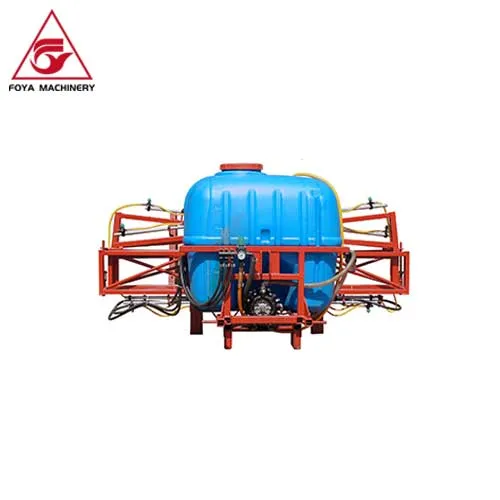
For open-field row crops — maize, wheat, soybean, cotton, sunflower — the next step is a tractor mounted boom sprayer. If you already own a tractor, this is the cheapest horsepower boost you can buy for your spraying operation.
The FOYA boom sprayer is built for the small-to-mid tractor range of 25-80 hp. The tank holds 200-800 liters, which sounds small next to a self-propelled unit but is exactly right for the 5-20 hectare stage. What matters more than the tank is the boom: 6-14 meters, hydraulic folding, with section valves so you can shut off individual sections in headlands and near the field edge. The diaphragm pump delivers 30-80 liters per minute at 2-6 bar — enough pressure for either flat-fan nozzles on open ground or the heavier volumes some crops need.
Why this stage matters: it's your first chance to spray at speed without sacrificing coverage. A 10-meter boom at 8 km/h covers roughly 5 hectares per hour. That's fifty times the output of a backpack. You'll also learn the fundamentals — nozzle angle, spray height, water volume per hectare — on a machine that's forgiving and cheap to maintain.
3. Year 2–3 — The Tractor Mounted Orchard Sprayer (Trees and Dense Canopies)
Somewhere around year two, farms with fruit trees hit a wall. A flat boom sprayer simply cannot reach the center of a mature mango, apple, or citrus canopy. Air-assisted spraying is not a luxury here — it's the difference between controlling pests and losing half the crop.
Enter the tractor mounted orchard sprayer. The FOYA unit carries a 500-1500 liter tank and pushes spray into the canopy with a large axial fan. The fan generates the air blast that lifts and rolls leaves so droplets reach the underside where most pests actually live. The 6-12 meter spray width and diaphragm or centrifugal pump (matching your tractor's 40-80 hp) cover a full tree row in one pass on each side.
A common mistake here is skipping this stage and buying a bigger boom machine. If you have any significant tree block — even 3 hectares of mature trees — the farm economics demand an air-assisted sprayer before you expand the boom width.
4. Year 3–5 — The Self-Propelled Orchard/Farm Sprayer (Go Big on Your Own Feet)
By years three to five, the two things holding your operation back are usually time and labor availability during peak spray windows. That's when the self-propelled orchard sprayer earns its keep.
The FOYA self-propelled unit is a complete spraying platform — an engine in the 25-50 hp range, a 800-2000 liter tank, and a spray width of 8-15 meters, available in 2WD or 4WD with an operating weight of 1200-2500 kg. Because it's self-propelled, it doesn't tie up your main row-crop tractor during the busiest weeks. One machine, one operator, no hitching and unhitching, no PTO belt worries — just drive to the block and spray.
4WD matters on soft orchard floors and in wet clay. The wider track options protect tree roots and reduce soil compaction compared with running repeated tractor passes. For a farm that's grown past 15-20 hectares of trees, or for custom-service operators who spray neighbors' blocks for a fee, the self-propelled stage is where the capital expense finally pays back.
Side by Side — The Three FOYA Sprayers Compared
| Specification | Boom Sprayer | Orchard Sprayer | Self-Propelled |
|---|---|---|---|
| Tank capacity | 200 – 800 L | 500 – 1500 L | 800 – 2000 L |
| Spray / boom width | 6 – 14 m (foldable) | 6 – 12 m | 8 – 15 m |
| Pump | Diaphragm, 30–80 L/min | Diaphragm / Centrifugal | Engine-driven package |
| Pressure | 2 – 6 bar | Fan-assisted (air blast) | 2 – 6 bar + fan option |
| Power source | Tractor 25 – 80 hp | Tractor 40 – 80 hp | Engine 25 – 50 hp (2WD/4WD) |
| Weight / class | Hitch mounted | Hitch mounted | 1200 – 2500 kg |
| Best crop | Maize, wheat, soy, open field | Mango, citrus, apple, vineyard | Mature orchards, custom service |
| Ideal farm stage | 5 – 20 ha open field | 3+ ha established trees | 15 – 20+ ha or rental service |
5. The Upgrade Telling Sign — and Three Rules to Follow
Here's the honest truth about timing: the right moment to upgrade isn't when your current sprayer fails — it's when the cost of not upgrading eclipses the purchase price. Look for these signals:
- The spray window is shrinking. When canopy pests or mildew require a 48-hour response window and your current machine can't cover the acreage in time, you're losing crop value every hour you delay.
- Your tractor is over-committed. If the same 60 hp tractor must plant one field, spray another, and cart fruit from a third, it's a sign you've reached the self-propelled stage.
- You're paying for outside application. Hiring a contractor to spray because your own rig "isn't fast enough" means you're renting exactly the capacity a purchased upgrade would return.
Three rules I share with every farmer I talk to:
- Match the machine to your tractor, not to your ambition. A 14-meter boom on a 25 hp tractor is a bad day in any field. Let the pump and boom specs — and the required PTO horsepower — lead your decision.
- Buy for next year's area, not this year's. A machine that matches you exactly today will hold you back next season. One size of capacity headroom is usually the sweet spot.
- Never skip the air-assisted stage if you have steady tree blocks. Flat boom coverage on trees is quietly costing you more in control failures than the orchard sprayer's price.
Farmer's take — Lu, Sultanpur, India:
"I moved from a backpack to a FOYA boom sprayer in year one for my paddy, then added the orchard sprayer when my mango block matured in year three. This season I'm running two machines off my 75 hp tractor. I stopped hiring contract sprayers two years ago, and the savings paid for the second machine."
Final Verdict — Plot Your Five Years
There is no single "best crop sprayer." There is only the best machine for your farm's stage. The five-year path is predictable:
- Year 0: Backpack sprayer for plots under 2 hectares.
- Year 1–2: A tractor boom sprayer (200-800 L, 6-14 m) once open-field crops pass 3-5 hectares.
- Year 2–3: An air-assisted orchard sprayer (500-1500 L) when tree blocks demand canopy penetration.
- Year 3–5: A self-propelled sprayer (800-2000 L) when labor windows shrink and your tractor gets over-committed.
Follow that order and every machine pays for itself before you outgrow it. Jump ahead, and you'll be paying for capability you're not using — or worse, struggling with a rig your tractor can't properly drive. Take stock of your acreage, your tree blocks, and your tractor's horsepower, and buy the step that fits right now.
🚜 Related FOYA products mentioned in this guide:
- • Tractor Mounted Boom Sprayer — 200-800 L tank, 6-14 m foldable boom, diaphragm pump 30-80 L/min
- • Tractor Mounted Orchard Sprayer — 500-1500 L tank, axial fan, 6-12 m spray width for tree canopies
- • Self-Propelled Orchard Sprayer — 800-2000 L, 25-50 hp engine, 2WD/4WD, 8-15 m spray width
Not sure which stage your farm is at — or which sprayer matches your tractor? We've helped growers in over 50 countries pick the right spraying platform. Chat with us on WhatsApp or email mandy@myfoya.com — tell us your crop, acreage, tractor model and tree blocks, and we'll map out your upgrade path for you.